Give your AI agents a barcode
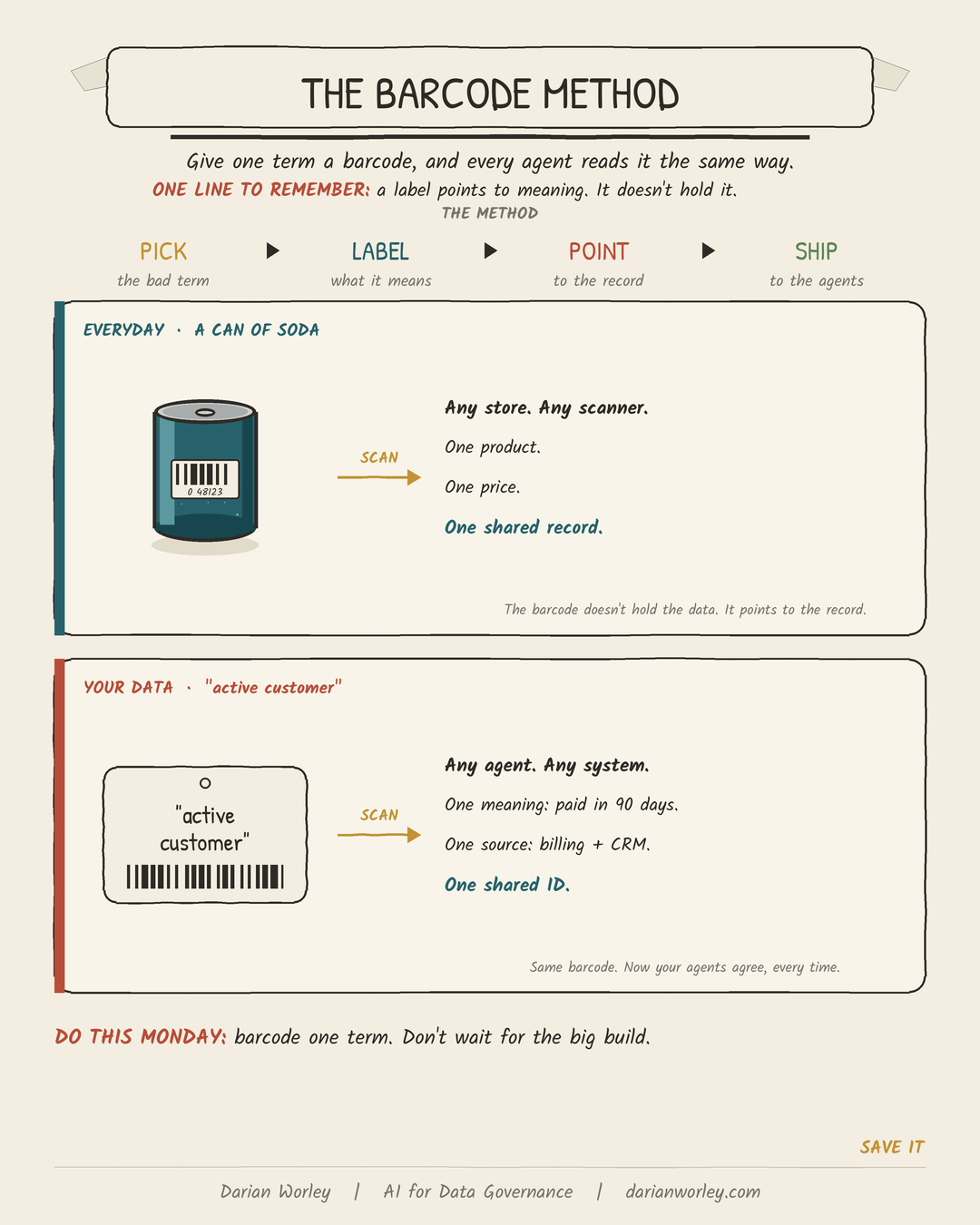
A barcode doesn't hold what's in the box. It points to it.
Early in my career I worked in product data at Coca-Cola, where billions of cans taught me how barcodes actually work. The UPC code on a Coke can is only 8 digits, not because the drink is simple but because the can is small. There's no room for the full number, so it gets compressed, and behind it sits a longer GTIN. The barcode doesn't describe the product. It just identifies which one it is.
Twenty years later, that's the exact thing your AI agents need. They don't fail on the model; they fail on meaning. Two agents read "customer" from two different systems and give two different answers, so before you can trust them they need shared meaning across the business.
You don't have to boil the ocean
Building that shared meaning fully is a big program. It's real work, worth doing. But it takes time, and your agents need answers this quarter. Here's what took me two decades to see: you don't have to finish the whole model to get shared meaning. You can start with a label.
GS1 didn't wait to catalog every product on earth. It standardized the barcode first, one small tag every box carries, and the entire supply chain runs on that one light standard. You can do the same for your agents with two thin moves.
Definitions are labels. Master data is a pointer.
Definitions are labels. You tag a term once ("here's what churned means here"), agreeing what it means without rebuilding the business to do it.
Master data is a pointer. When the same customer lives in three systems, you decide billing wins for the balance and the CRM wins for the email, using golden IDs that point into what you already run.
This isn't a detour from the bigger model. It's the on-ramp. Every term you agree on now is one that model inherits later, except you get the value first. So while the larger data work runs, ask a smaller question in parallel: what ten terms do your agents keep getting wrong, and what does each one point to? Label those ten and ship this quarter.
Only 7% of enterprises say their data is ready for AI, according to Cloudera and Harvard Business Review this year, and most are waiting on the finished build. You don't have to.
They say hindsight is 20/20. Looking back, that barcode on a can taught me more about AI governance than any framework ever did.
What's the one term your agents keep getting wrong? Name it.
Tell me. I read everything.